New Survey Sets Maximum Size for Hors d'Oeuvres: One Bite, Two Chews
Cocktail party guests say some hors d'oeuvres are too big to eat while standing, drinking, and talking.
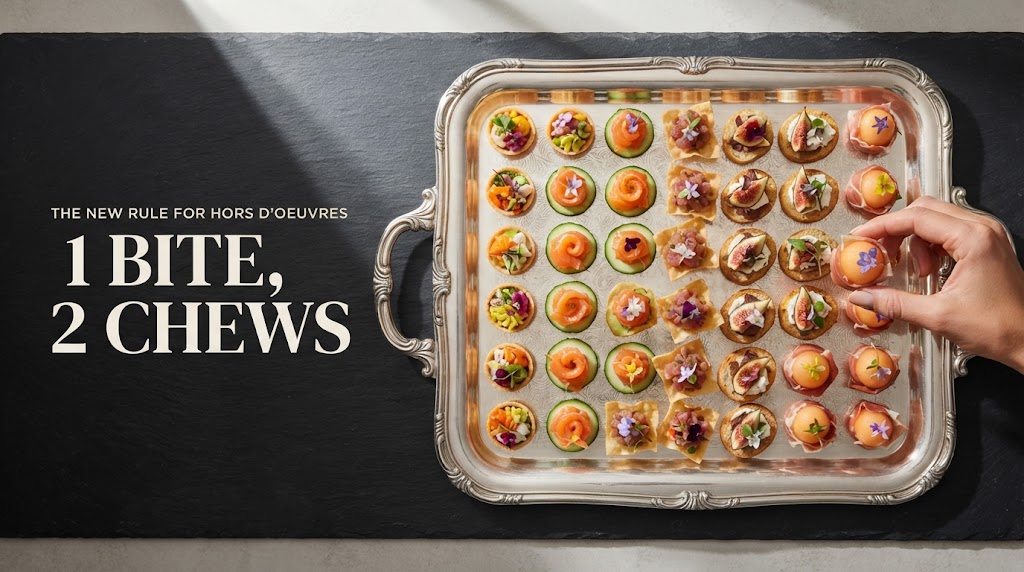
WASHINGTON — A new survey of event attendees by the Institute for Hands-Free Mingling has confirmed what cocktail-party guests have long suspected but were too polite to say with their mouths full: an hors d'oeuvre should never be larger than one bite or take more than two chews. Of the 1,200 guests polled, 9 in 10 said they had been trapped mid-conversation with a half-eaten croquette, a wet napkin, and a drink, unable to shake a hand. The remaining 1 in 10 was holding a ficus.
Etiquette guides have said as much for years. The Etiquette Method advises choosing hors d'oeuvres that can be eaten in one bite, and a University of Oklahoma dining guide counsels small bites so a guest can swallow before speaking. The industry kept handing people a three-bite meatball anyway and asking them to describe their career.
One attendee, Pamela Voss of Bethesda, said she has spent the last decade of receptions holding a skewer like a cigarette, nodding at a CEO while the shrimp cooled in her hand. "He asked what I do for a living," she said. "I said 'mm-hmm.' I got promoted anyway, which tells you something about the quality of the questions."
The hardest resistance has come from the kitchen. Chef Laurent Bellweather, whose braised short rib slider has been described as "architecturally ambitious," defended the portion. "A bite is a statement," he said. "Some statements need to be made in four parts, with a fork you don't have." Pressed on where guests are meant to put the fork, he said, "That's a front-of-house issue." One venue, according to attendees, brought out the whole kitchen table, along with what several guests described as "the chairs."
The Restaurant Problem
Restaurants hired to cater a party almost always overshoot. A kitchen trained to feed people sitting down will shrink the entrée instead of inventing the bite, and the result is a small dinner handed to a guest with no table, no fork, and a stranger waiting for an answer. The experienced caterer starts from the other end: what can a person eat in one motion, with one hand, and keep talking?
The Goldilocks Problem
The lesson, it turns out, can be overlearned. In the early days of Danny Meyer's catering company, then new, the staff delivered a holiday party at the home of William F. Reilly, then CEO of Primedia. The hors d'oeuvres arrived in portions so dainty that the room spent the evening in quiet pursuit of the next tray. The guests, executives accustomed to being fed, complained. Not about the quality, which was excellent, but about the scale. The kitchen had heard "one bite" and delivered "one regret."
Make it too big and the guest cannot speak. Make it too small and the guest cannot stop looking for you. One bite is not a size. It is a judgment.
"My rule is one bite, two chews."
At press time, a passed tray of mini beef Wellingtons was seen entering the room, each one the size of a paperback.